





Imagine a Nigeria where no child goes to bed hungry, where widows in remote villages receive support without pleading, and where a farmer whose home is swept away by floods can rebuild his life within weeks. That vision is what the National Social Register (NSR) is quietly building across the country.
At a landmark stakeholder engagement in Lagos, leaders from government, states and development partners declared that the Social Register covering 70 million Nigerians in 19 million households is not just a database but the country’s boldest bet against poverty.
Dr Funmi Olotu, National Coordinator of the National Social Safety Nets Coordinating Office (NASSCO), described it as a lifeline not a ledger. “Behind every number is a mother who can send her child to school, a family that can withstand rising food prices, a community that can recover after floods. That is the true power of the Register,” she said.
Created in 2016 with World Bank support, the Register has become a living tool guiding interventions that are timely, transparent and targeted. Its integration with the National Identification Number promises to make it more resilient, ensuring that every naira spent reaches the right household.
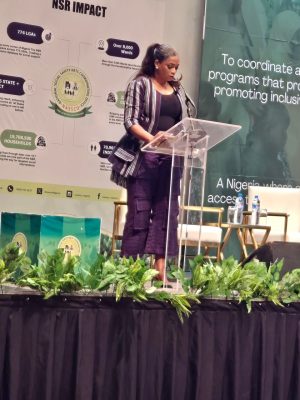
Governor Abdullahi Sule of Nasarawa State said the Register is not theory but reality. He recalled seeing villagers use ₦5,000 stipends to start small businesses and even provide boreholes. “If you want to see naked poverty come to our villages. The Social Register is not numbers, it is people, it is dignity and it is hope,” he said. Nasarawa has already enrolled 1.9 million people, more than half its population.
The Minister of Education, Dr Alausa, represented at the event, called the Social Register an enabler of inclusion. With accurate data, children at risk of dropping out can be identified and supported. “No child must be left behind,” he insisted, linking it to President Tinubu’s Renewed Hope Agenda.
Assoc Prof Badamasi Lawal, Chief Executive of the National Social Investment Programme Agency, said the Register embodies government’s pledge to leave no Nigerian behind. He noted that over 8.1 million households have received ₦25,000 cash transfers, with nearly ₦393 billion disbursed. “When the income of the poor rises the wealth of the nation rises,” he said.
The Social Register has also proven useful during disasters. When floods devastated Yelwa in Borno State, it guided rapid aid delivery without delay or manipulation. International partners including the World Bank, UNICEF, WFP and ILO said this showed Nigeria’s safety net can match global standards.
NASSCO also honoured leaders whose dedication has sustained the Register. Awards went to the governors of Nasarawa, Borno, Katsina, Lagos and Niger States, the Minister of Finance and other reform champions.
By March 2026, every household in the Register will be verified through NIN, eliminating duplication and fraud. With inflation straining families, the Register is set to become Nigeria’s most reliable cushion against poverty.
As Dr Olotu concluded “The Social Register is our national promise to protect the weak, restore dignity and give hope. Walk with us. Stand with us. Let us ensure no Nigerian is left behind.”
By Folake Sokoya
For inquiries and advert placements please email [[email protected]](mailto:[email protected]). Visit fasnewsng.com for more.