




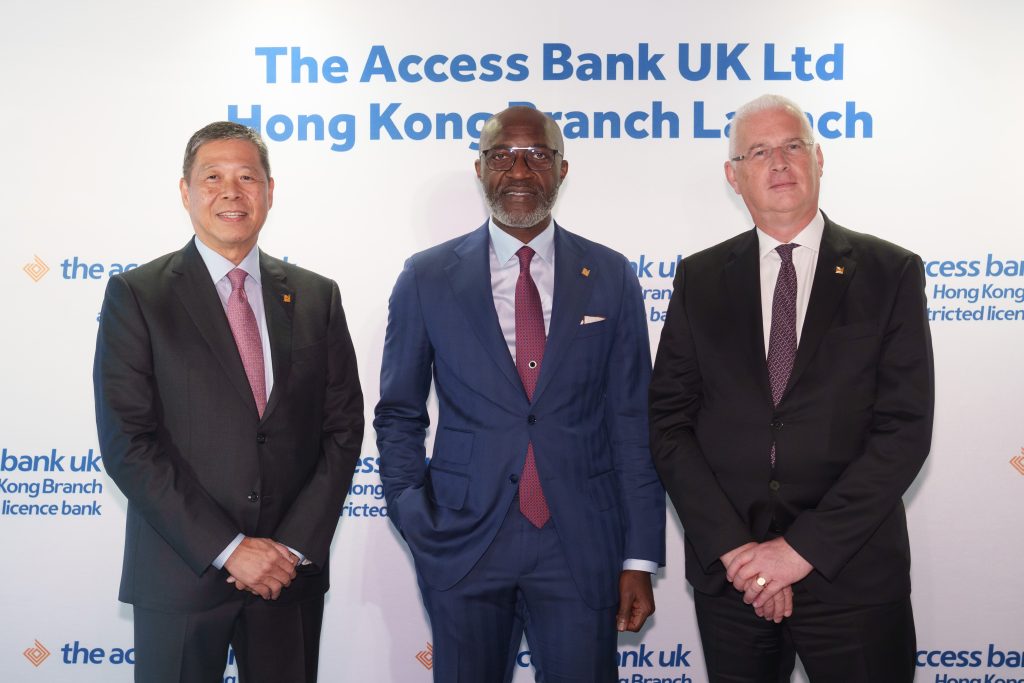

In a significant stride toward enhancing its global footprint, The Access Bank UK Limited has officially inaugurated its Hong Kong branch today.
This move, making it the first West African bank to establish a presence in Hong Kong, reinforces the bank’s commitment to facilitating trade flows between Asia and Africa. Operating under a restricted license, the Hong Kong branch is poised to play a pivotal role in bolstering trade ties, particularly amid the booming Asia-Africa economic relationship.
Positioned in the heart of Hong Kong’s financial district, this new branch leverages Hong Kong’s reputation as a leading international financial center. As a bridge to Asia, Hong Kong is strategically positioned to act as a hub for facilitating trade between Asia and Africa. Jamie Simmonds, CEO & Managing Director of The Access Bank UK Limited, emphasized the timeliness of this expansion: “Asia has emerged as Africa’s largest trading region. In 2023, China-Africa trade hit a historic high of USD 282.1 billion. Our presence in Hong Kong ensures we meet the growing demand for financial services supporting trade in these dynamic markets.”
Ambassador Oludare E. Folowosele, Consul General of the Nigerian Consulate in Hong Kong, lauded the branch’s opening, marking it as a major milestone in deepening trade ties. “This is a huge milestone in the development of trade flows between Asia and Africa as the first West African banking group to attain this status,” said Folowosele. He noted the alignment with China’s Belt and Road Initiative, which promotes economic cooperation between China and Africa.
Ernest Law, Managing Director & CEO of the Access Bank Hong Kong Branch, highlighted the branch’s focus on tailored financial solutions. “This expansion allows us to provide customized trade finance and commercial banking services to our clients in Hong Kong and the Asia-Pacific region, strengthening our global reach.”
The new Access Bank UK Hong Kong branch will initially staff about 25 professionals and aims to expand strategically over time.
By Augustine Idoje